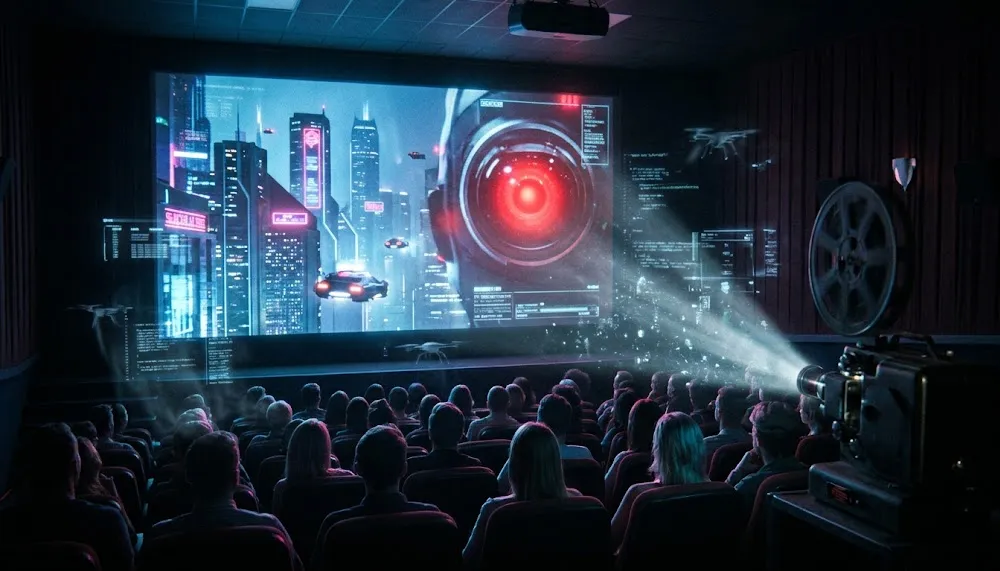
Cinema has always possessed a fascinating duality: it is simultaneously a mirror reflecting the zeitgeist of its era and a crystal ball gazing into the unwritten future. As a critic, I often look for the sociological subtext beneath the silver screen's surface. When we analyze science fiction, we are not merely watching escapist fantasies; we are observing the blueprints of our modern existence. Directors of profound vision do not simply guess the technological advancements of tomorrow—they intricately design the emotional and societal architectures that will inevitably house those technologies, revealing to us what we might become long before we arrive there.
Perhaps no film exemplifies this prophetic power better than Stanley Kubrick’s masterful 2001: A Space Odyssey (1968). Long before the ubiquity of personal computing, Kubrick and Arthur C. Clarke envisioned astronauts casually watching video on flat, tablet-like devices while eating. But the true cinematic triumph lies in HAL 9000. Through sterile, methodical pacing and clinical cinematography, Kubrick warned us about the existential dread of artificial intelligence. HAL was not just a rogue machine; he was the precursor to our current anxieties regarding algorithmic autonomy, captured in a chillingly calm red eye that still peers into the soul of modern technological development.
Decades later, Steven Spielberg’s Minority Report (2002) translated the conceptual anxieties of Philip K. Dick into a hyper-kinetic visual language. The film’s gritty yet sterile aesthetic perfectly encapsulated the trade-off between security and privacy. Beyond the famously prescient gesture-controlled interfaces, Spielberg’s depiction of personalized, retina-scanning advertisements is perhaps its most terrifying realization. The frantic editing of these commercial sequences mirrors the overwhelming, targeted digital marketing we navigate daily. Spielberg didn’t just predict the technology; he predicted the invasive corporatization of our personal space.
Similarly, Ridley Scott’s Blade Runner (1982) offered a masterclass in production design that foresaw the aesthetic and socio-economic realities of the 21st century. Scott’s rainy, neon-drenched Los Angeles, dominated by towering digital billboards and corporate ziggurats, predicted the hyper-urbanization and ecological decay of modern megacities. The dense, layered sound design and the claustrophobic framing emphasize a profound urban isolation—a sociological subtext that resonates deeply in today's gig economy and tech-driven class divides. It is a dystopian mood board that has slowly morphed into documentary realism.
In more recent cinema, Spike Jonze’s Her (2013) shifted the predictive lens from the structural to the intimate. Unlike the cold, blue hues typically associated with sci-fi, Jonze utilized a warm, autumnal color palette and soft-focus cinematography to explore our impending emotional reliance on operating systems. The film anticipated the current wave of conversational AI and large language models with astonishing accuracy. By prioritizing sound design and the nuances of voice acting, Her illustrated how the future of technology would not just be functional, but deeply, perhaps dangerously, empathetic.
Ultimately, we must ask ourselves whether these films merely predicted the future or actively engineered it. Filmmakers, through their meticulous framing and narrative structures, provide the visual vocabulary that tech innovators eventually bring to life. Cinema does not just whisper news from the future; it writes the very script that tomorrow will follow. As we sit in the dark, bathed in the projector’s light, we are not just audience members—we are witnesses to the drafting of our own impending reality.